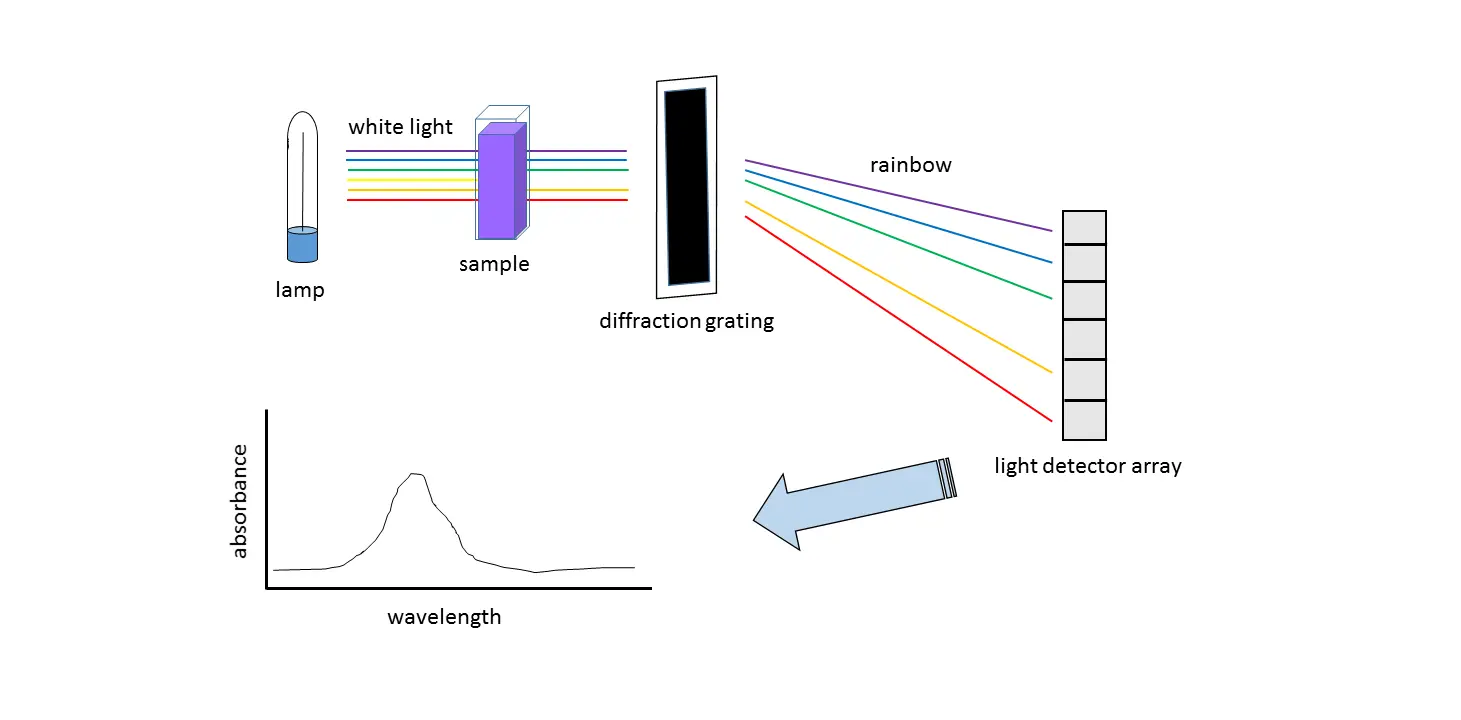
Spectroscopy
The measurement and study of a light spectrum is called optical
spectroscopy. Originally, spectroscopy was primarily concerned with the
study of visible light and its wavelength dispersion, but later the
concept was extended to the study of interactions between matter and
electromagnetic radiation of any frequency. Through optical
spectroscopy, it is possible to characterize a material noninvasively
and nondestructively.
Infrared spectroscopy (IR spectroscopy or vibrational spectroscopy) is the measurement of the interaction of infrared radiation with matter by absorption, emission, or reflection. It's a technique normally used in analytical chemistry and material characterization, as well as in physical chemistry for the study of chemical bonds. It's a simple and reliable technique widely used in both organic and inorganic chemistry, in research and in industry. When IR radiation is absorbed by a molecule, it transitions from its fundamental vibrational state to an excited vibrational state. If a material is not completely transparent, absorption and consequently transitions between vibrational energy levels will occur. In the latter case, the recorded spectrum will be characterized by a series of peaks of varying intensity for each transition.
Raman spectroscopy is a spectroscopic technique typically used to determine vibrational modes of molecules, although rotational and other low-frequency modes of systems may also be observed. Raman analysis is widely used in the study of materials, whether in the solid or liquid state or in the gas phase. It is a nondestructive technique that gives answers in a short time, does not require special conditions for performing the measurement, and can be carried out directly on the sample without any preparation.
THz spectroscopy is a special spectroscopy technique that is based on THz radiation, also called submillimeter radiation. THz spectroscopy provides a particularly powerful method for resolving and controlling individual transitions between different many-body states. Different electronic excitations within semiconductors are already widely used in lasers, electronic components and computers. THz spectroscopy on semiconductors is relevant in revealing both new technological potentials of nanostructures as well as in exploring the fundamental properties of many-body systems in a controlled fashion.
CARS (Coherent Anti-Stokes Raman Spectroscopy) is a type of spectroscopy used mainly in chemistry, physics and related fields. It is based, like Raman spectroscopy, on the nuclear vibrations of chemical bonds. Unlike Raman spectroscopy, CARS uses multiple photons to select molecular vibrations and produces a coherent signal.
SRS (Stimulated Raman Spectroscopy) is a technique similar to CARS. In SRS, as in CARS, both pump and Stokes photons are incident on the sample; if the frequency difference (pump and Stokes) corresponds to a molecular vibration, then stimulated excitation of the vibrational transition occurs.
Time-resolved Spectroscopy is the study of dynamic processes in materials or chemical compounds using spectroscopic techniques. Typically, the processes are studied after the illumination of a material, but, in principle, the technique can be applied to any process that leads to a change in the properties of a material. Through the use of ultra-short pulse lasers, it is possible to study processes that occur on time scales of as little as 10 to 16 seconds. The most common time-resolved spectroscopy techniques are:
Transient-absorption Spectroscopy
Time-resolved infrared spectroscopy
Time-resolved fluorescence spectroscopy
Time-resolved photoemission spectroscopy
Time-resolved Two-photon photoelectron (2PPE) spectroscopy
In spectroscopy, lasers are used as precise and tunable light sources to analyze the composition, structure, and properties of materials. The most commonly used lasers in spectroscopy include diode lasers, tunable dye lasers, Nd:YAG lasers, and quantum cascade lasers, each selected based on the spectral range, resolution, and sensitivity required.
Diode lasers are widely used in techniques like absorption and Raman spectroscopy. They offer excellent wavelength control and are ideal for compact, cost-effective systems, especially when studying gases or liquids with well-defined absorption features.
Tunable dye lasers provide a broad and adjustable wavelength range, making them ideal for fluorescence spectroscopy and high-resolution molecular studies. Their flexibility allows researchers to scan across many different wavelengths and detect subtle spectral signatures.
Nd:YAG lasers are powerful pulsed lasers commonly used in laser-induced breakdown spectroscopy (LIBS) and Raman spectroscopy. They deliver high-intensity light, enabling the analysis of solid materials, surface composition, and trace elements.
Quantum cascade lasers are used primarily in mid-infrared spectroscopy, ideal for detecting molecular vibrations and chemical bonds. They are valuable for environmental monitoring, medical diagnostics, and industrial process control due to their ability to target specific absorption bands.
The choice of laser in spectroscopy depends on the spectral region, the sample type, and the desired sensitivity and resolution. Diode lasers are common for compact and precise systems, dye lasers offer broad tunability, Nd:YAG lasers provide high-energy pulses for strong signals, and quantum cascade lasers are key for mid-IR applications.